The Falcon Rises in Indy: Re-Falcon 030 and the Quest for Digital Immortality
I actually sat down at my desk this past weekend with every intention of making progress on my own coding projects. I had my environment ready, but as I was settling in, a stray Facebook notification caught my eye. I don’t check it often, but this one stopped me: the Re-Falcon was on display at the Indy Classic expo.
I did a quick mental map: Wait, that’s only two hours away? That was well within range for my Chevy Bolt! Within twenty minutes, I was in the car on my way. My wife tagged along for the ride, and while I’m fairly certain she wasn’t quite as invested in 30-year-old motherboard revisions as I was, she could see my excitement.
For the two or three of you who follow this blog, you know there were plenty of other things to see at the Wyndham—rows of old PCs and various retro gear. While I have nothing against those old PCs, I couldn’t care less about them. To me, they’ve always felt bland. The real magic was always in the Commodore, Apple, and Atari ecosystems. Those machines had “soul.” The PC? It was just a box.
From the ST Trenches to the Falcon’s Flight
For those who remember my Atari ST at 40 post, the ST wasn’t just a hobby for me; it was my development environment.
In the early 90s, I was a licensed Atari ST developer. I spent my time developing apps for GEM in K&R C (with a little 68000 assembly) on the Atari ST. When the Falcon 030 arrived in ‘92, it felt like the promised land. With a 32-bit internal bus and that legendary Motorola 56001 DSP, it was the “multimedia” powerhouse we had been waiting for.
The Great PC Pivot (and the “Bland” Years)
Unfortunately, the timing was bittersweet. I was in my senior year of college when Windows 3.1 hit the scene, and the writing was on the wall. To prepare for a career in Windows development, I made the pragmatic choice: I got a 386DX/40 instead of a Falcon.
I ran my ST simultaneously for a while, but I spent the next five years digging into Visual C++ (although it wasn’t really that “Visual”) until Java and the web eventually came along. To be fair, Windows finally got “decent” with Windows 2000 and XP—they were solid, dependable tools. But that’s all they were: tools.
Finding the “Happy” Again
It wasn’t until years later, when I picked up a Mac Mini running Snow Leopard to start working on app development for the iPhone, that I felt that spark again. I’ve been on the Mac ever since (with a little bit of Linux in the mix). Like the ST, the Mac felt like it had a point of view.
Looking back, I’ve had countless PCs at home and work over the decades, and I don’t even remember what hardware was in them at this point. They were just boxes. But my Atari and Mac computers? I remember every single one. They were environments I actually wanted to live in.
The Crossroads: Falcon vs. Jaguar
When the Falcon was released, Atari was at a critical junction. They had to decide whether to double down on the high-end computer market or bet everything on a new game console. They attempted both, but the reality was they only had the capital to sustain one.
Atari eventually chose the Jaguar, and we all know how that ended. At the time, chasing the mass-market console world seemed like the right choice. In retrospect? I’m not so sure. A computer focused specifically on music production could have occupied a niche that no other machine could touch.
Even after Atari abandoned the computer market, the Falcon refused to die. C-Lab stepped up to keep production going because the machine was such an integral part of their music production ecosystem. Working at Sweetwater, I can’t help but wonder: if Atari had stayed the course and leaned into that dedicated music system path, would we be selling the latest “Falcon 2026” on our website today? While my colleagues in the Distribution Center (where I’ve been known to pitch in from time to time—we all do here!) would be the ones actually moving the boxes, I’d certainly be the first one in line to buy one. I often wonder what that path looks like in the metaverse.
Resurrecting the 030: The Re-Falcon Project
Meeting Steve Suavek and seeing the Re-Falcon 030 motherboard in the flesh brought those “what ifs” back to the surface. Today, a used Atari Falcon in decent condition is selling for $2,000 or more. To put that in perspective, that’s exactly what I paid for my Mac Studio a few years ago!
The Re-Falcon isn’t a modern emulation; it is a meticulous, 1:1 motherboard replacement. It provides a brand-new, reliable home for the original proprietary Atari custom chips that are so often stranded on dying, corroded original boards.
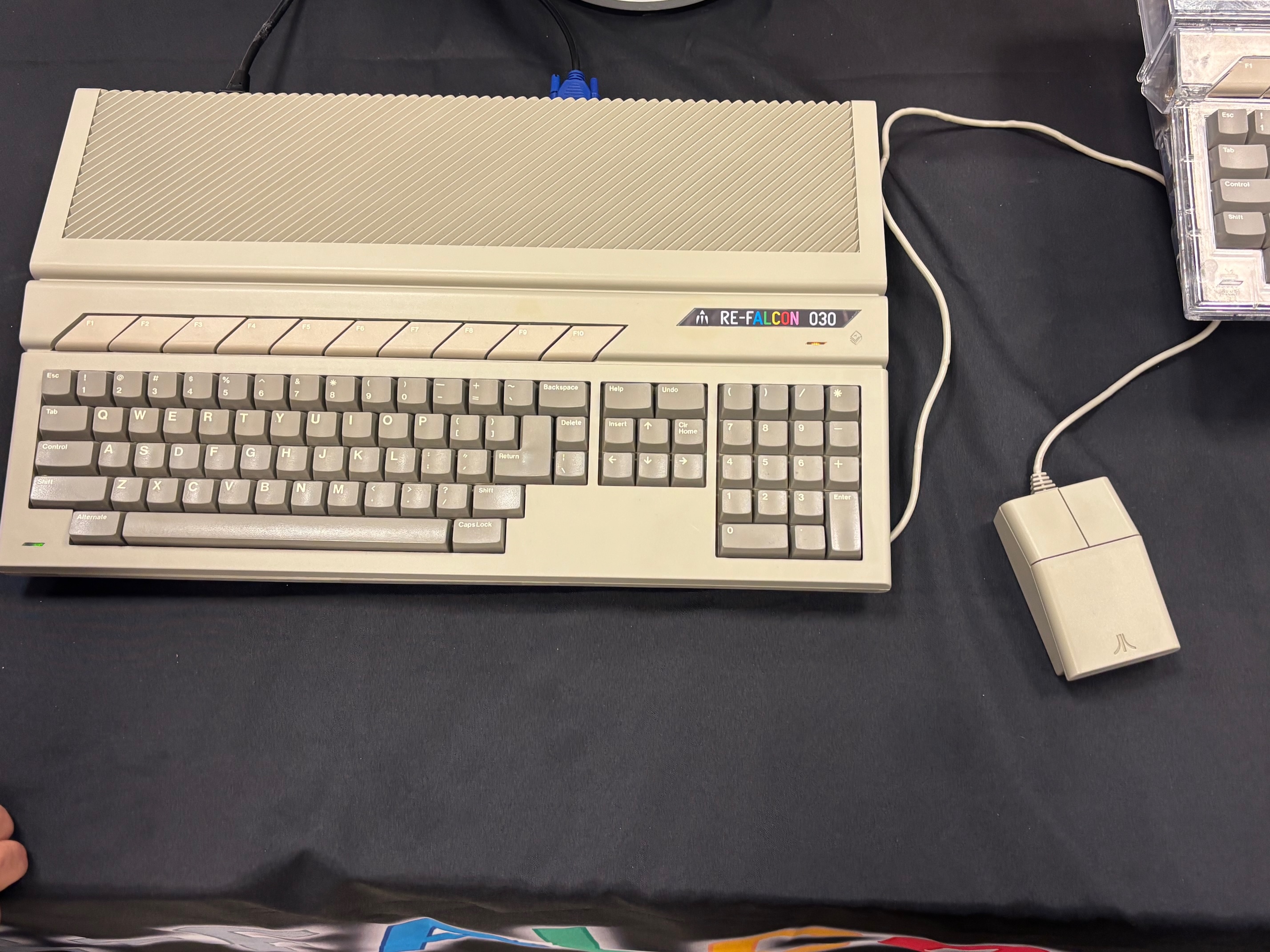 The original Atari Falcon 030 case, looking pristine with custom Re-Falcon branding—the ultimate “stealth” upgrade.
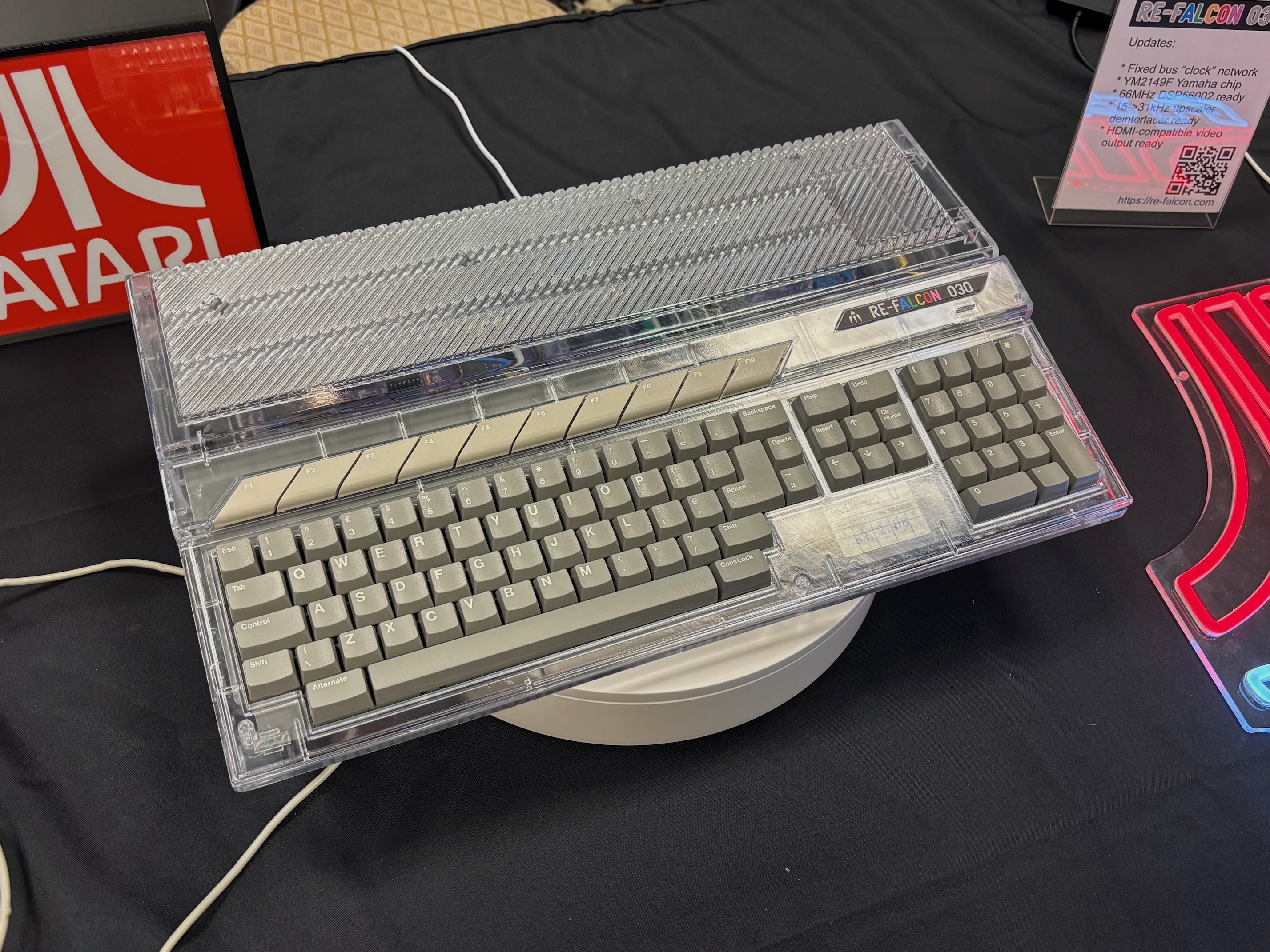 A 1992 dream made manifest: The Re-Falcon 030 in a clear plexiglass case, showing off the internal engineering.
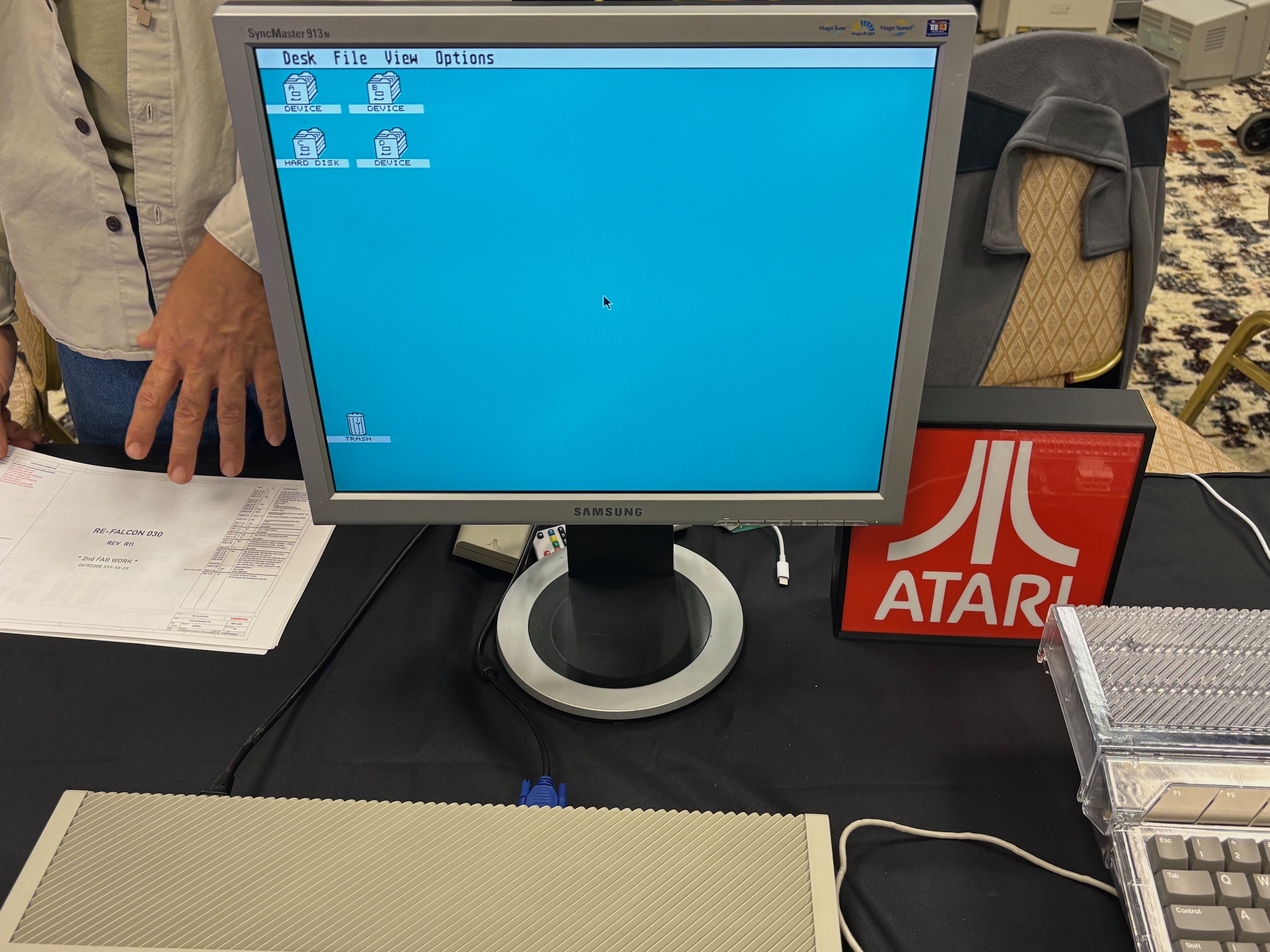 The legendary Atari “TOS” desktop running live.
The Man Behind the Mission
Meeting Steve was a highlight of the trip. Standing there with the bare Re-Falcon 030 PCB, he had a smile that only a developer who has successfully navigated 4,440 pads and 2,420 vias can truly wear. You can see it in his face—this is a man proud of his work, and rightfully so! It’s the look of someone who didn’t just talk about “saving the platform” but actually sat down and did the grueling work to make it happen.
The Engineering Feat
According to the technical fact sheet Steve had on display, the sheer complexity of this undertaking is staggering:
- 825 Total Components (345 on top, 480 on bottom)
- 4,440 Pads and 2,420 Vias
- 64,910 Individual Tracks
- 6-to-8 Layer PCB Stackup
Seeing it in a clear case running the classic desktop was a 1992 dream finally perfected for today.
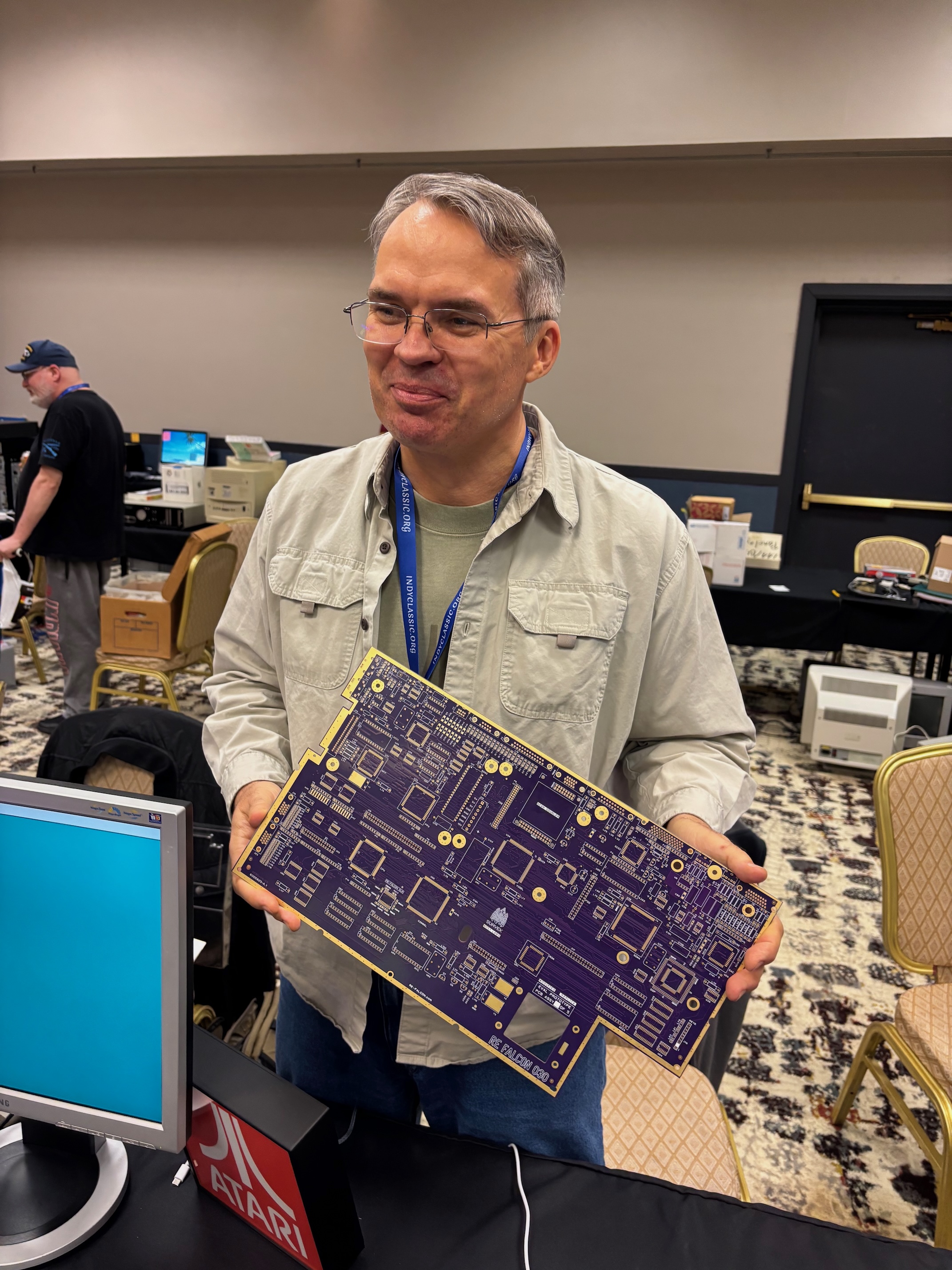 Steve Suavek displaying the bare Re-Falcon purple PCB. You can really see the complexity of those 64,910 individual tracks here.
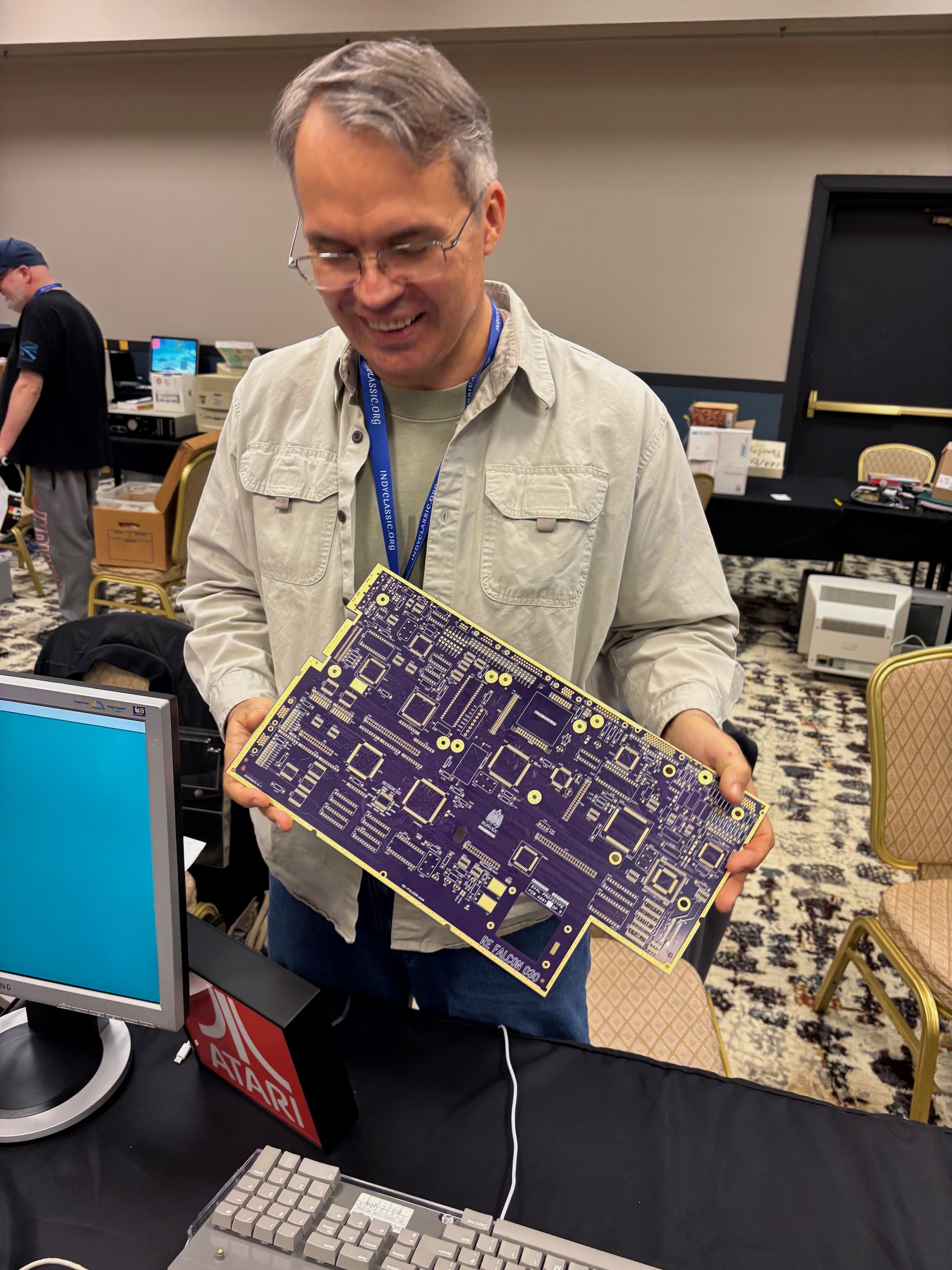 It’s staggering to think this board holds 825 components in a meticulous 1-to-1 replacement layout.
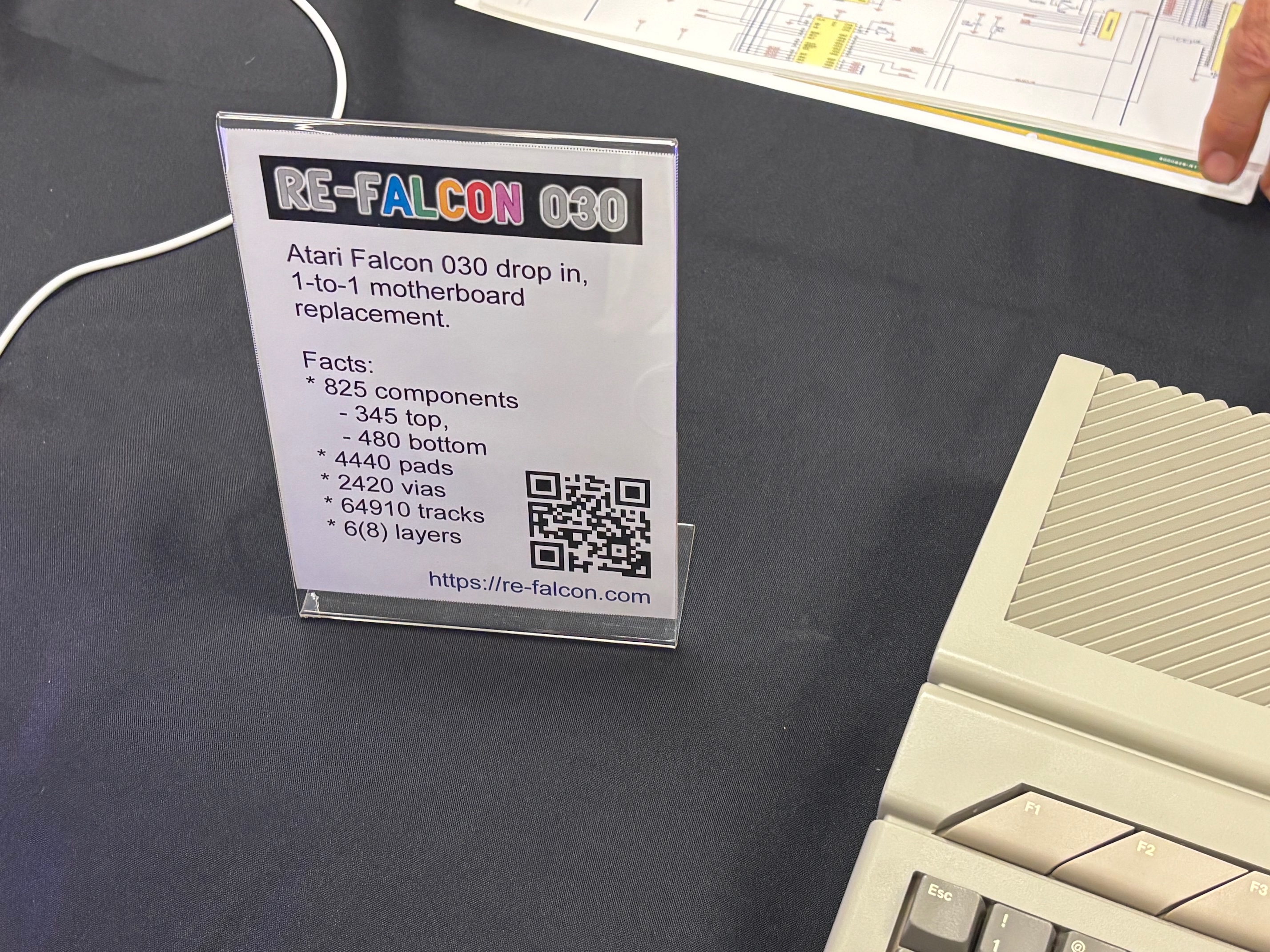 The “Tale of the Tape”: The official technical fact sheet from the booth, detailing the 6-to-8 layer PCB stackup.
The Final Frontier: The Decap Initiative
While the Re-Falcon provides the physical sanctuary, we are still tethered to a finite supply of “donor” chips. To make the Falcon truly immortal, we need FPGA recreations of the “Big 3” custom ICs: the COMBEL, VIDEL, and the SDMA.
This is why I’m now following the Atari Falcon custom chips decap initiative. Led by Miro Kropáček (mikro), this is true “Digital Archaeology.” They are chemically decapping original silicon and taking thousands of microscopic photos to map out the logic gates. After coming back from Indy this weekend, I made a small donation to this effort. It’s a small investment in ensuring these machines are still making music 30 years from now.
The Road Ahead
The scale of this task is massive. For the VIDEL chip alone, a specialized lab in Taiwan had to take over 7,500 high-resolution images at 500x magnification. The total cost to get the die shots for the set is over $8,000 USD.
As someone who uses AI to help manage my own coding repos and tech projects, I often wonder about its role here. While we don’t know for certain if the decap team is utilizing AI for pattern recognition yet, the potential for these tools to act as a “force multiplier” for such grueling manual work is immense.
Digital Immortality
At the end of the day, we aren’t just saving old silicon; we’re saving the work, the music, and the creativity that these machines enabled. Whether it’s through Steve’s incredible PCB work or the microscopic “archaeology” of the decap team, we’re ensuring that the Falcon doesn’t just become a memory.
Driving home in the Bolt, I kept thinking about that alternate timeline. Until that version of reality catches up with us, I’ll keep supporting the folks doing the hard work of bridging the gap. If you’ve got a few bucks to spare and want to see 1992 live forever, head over to the Decap Project and help them cross the finish line.
To the two or three of you still reading—thanks for coming along on this two-hour detour to Indy. Now, back to my own code.